

Heads Up: Blatant Boundary Violations and Surprise U-Hauls
Buckle up, this one involves staggering family entitlement and severe spatial trespassing. Expect a frustrating but deeply satisfying ride into the mechanics of saying “no” and meaning it.
Meet our main character: a self-sufficient professional who guards their peace, their private practice, and their property line with ironclad boundaries and zero apologies.
The Full Story: A Masterclass in Shutting Down Audacity?


Here is where the boundaries are drawn, quite literally in the architecture. Operating a private business from home, especially one requiring client discretion, demands strict compartmentalization. The upstairs isn’t just a living space; it is a legally and ethically protected professional environment.


Enter the classic catalyst for family drama: the underachieving sibling. The description of a brother who expects rewards without the requisite effort sets the stage for the precise breed of entitlement we are about to witness.


The sheer audacity here is breathtaking. To volunteer someone else’s home, without prior consultation, crosses the line from presumptuous into genuinely invasive. A surprise U-Haul is not a request; it is an ambush designed to force compliance.


This is a masterstroke of crisis management. Rather than engaging in a screaming match in the driveway, our homeowner responds to a logistical invasion with a logistical solution. Swift, decisive, and entirely detached from the emotional manipulation attempt.


The tour serves as a brilliant tactical maneuver. By showing the invading party exactly what they are being excluded from, and emphasizing the serious, clinical nature of the private practice, the host removes the mystique and replaces it with cold, hard reality.


A flawlessly executed containment strategy. The distinction is made crystal clear: You are not my guests. The physical deadbolt serves as a perfect metaphor for the psychological boundary that simply will not yield to family pressure.


The absolute gall of the parents’ silent expectations is laid bare here. Assuming a professional would dismantle their livelihood to accommodate a sibling’s failure to launch, without even having the courage to ask beforehand, is a stunning display of parental overreach.


The natural consequences of poor planning unfold perfectly. The discomfort of the parents, squeezed into a single bed, confronted with the realities of a newborn, is a crisis entirely of their own making. The homeowner’s detachment from their discomfort is both justified and necessary.


The audacity returns for a second act. Despite the chaos they personally orchestrated, the parents still attempt to quietly renegotiate the ironclad boundaries. Reminding them of the professional stakes is a firm, non-negotiable conclusion to a ridiculous request.


The final detail highlights how deeply this entitlement attempts to erode every facet of the homeowner’s life, right down to the pavement. Protecting client discretion over a brother’s convenience is the only correct professional choice.
The Deep Dive: Dissecting the Anatomy of Family Presumption
The Cast Breakdown: Who Was the True Architect of This Chaos in Disguise?
- The Unyielding Homeowner: A study in emotional regulation and structural discipline. They do not yell, plead, or negotiate; they simply hire movers, state the facts, and turn the lock. They represent the ultimate triumph of logic over guilt.
- The Overstepping Parents: While the brother is the obvious burden, the parents are the true agents of chaos here. They generously offer assets they do not own to solve problems they did not create, operating under the deeply flawed assumption that their child’s success is communal family property.
- The Freeloading Sibling: The passive beneficiary of the parents’ overreach. Floating through life on the assumption that a safety net will always be woven by someone else’s labor, he arrives with a U-Haul and zero self-awareness.
The Core Issue: Why This Problem Happens Everywhere
This scenario highlights a shockingly common phenomenon: the weaponization of “family obligation.” When one child becomes successful and independent, parents often blur the lines of ownership, viewing that success as a communal resource to subsidize a less stable sibling. It is a profound lack of respect disguised as family unity. The assumption that proximity dictates availability, that simply showing up forces a yes, is an invasive tactic used by families who refuse to recognize their adult children as autonomous individuals.
Plot Hole Check: Is This Story Too Wild to Be Real?
While the audacity of a surprise U-Haul feels cinematic, the narrative is grounded in stark realism. There are no cartoonish villain monologues or billion-dollar inheritances at stake here, just the mundane, deeply believable friction of parents treating an adult child’s home like an extension of their own property. The measured, professional response of the homeowner lends heavy credibility to the conflict.
The Final Update: Does the Deadbolt Hold?
What Happened Next
The familial standoff remains locked in a tense status quo. The invasive party is contained strictly to the basement suite, forced to live out the uncomfortable reality of the arrangement they secretly manufactured. The homeowner continues to run their private practice undisturbed, maintaining the integrity of their workspace while the consequences of the parents’ presumptuous invitations play out entirely downstairs.
The Hard-Earned Lesson
Boundaries are not about changing other people’s behavior; they are about dictating your own. Our main character couldn’t stop the U-Haul from arriving, but they could absolutely dictate where its contents went. We often believe that true peace requires a cooperative family, but this story offers a more pragmatic truth: sometimes, peace simply requires a well-enforced deadbolt and the willingness to let others sit in the discomfort of their own bad decisions.
Community Reactions: Dissecting the Audacity and the Mystery Profession
This reader rightfully points out that generosity does not equal a transfer of property rights. The resulting speculation about the homeowner’s highly confidential career proves just how effectively she maintains her professional mystique against family intrusion.


A sharp observation on how parents often regress to treating adult, property-owning children like dependents the moment family demands are involved. The collective realization about the main character’s specialized therapy career perfectly highlights why this boundary wasn’t just a preference, but an absolute professional necessity.


This commenter cuts straight through the emotional manipulation to the stark economic reality of the situation. It is a measured reminder that sacrificing one’s livelihood to appease entitled relatives ultimately bankrupts everyone involved.


The sheer admiration here is palpable, reflecting a collective envy from readers who struggle to hold the line with their own families. It is universally satisfying to witness someone not just state their limits, but enforce them with clinical precision.


This thread highlights a frustrating paradox: excessive kindness often breeds the very entitlement that eventually attacks it. A firm reality check is sometimes the only cure for a family that has mistaken generosity for weakness.


Sometimes the most authoritative response to manufactured drama is the simplest logistical fix. This delightfully dry suggestion shuts down the parents’ manipulative complaints without yielding a single inch of territory.








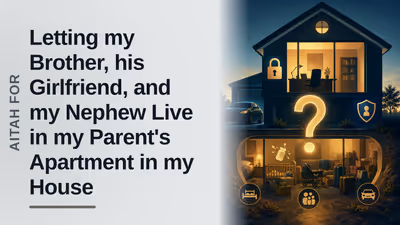
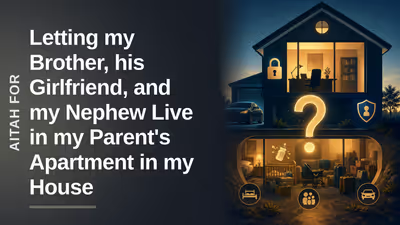



Right away, we must establish the baseline: our host has already been remarkably generous. Providing a beautiful, separate two-bedroom apartment for retired parents is an act of substantial familial devotion, not an assumed obligation. The physical separation is established early on.